

Method
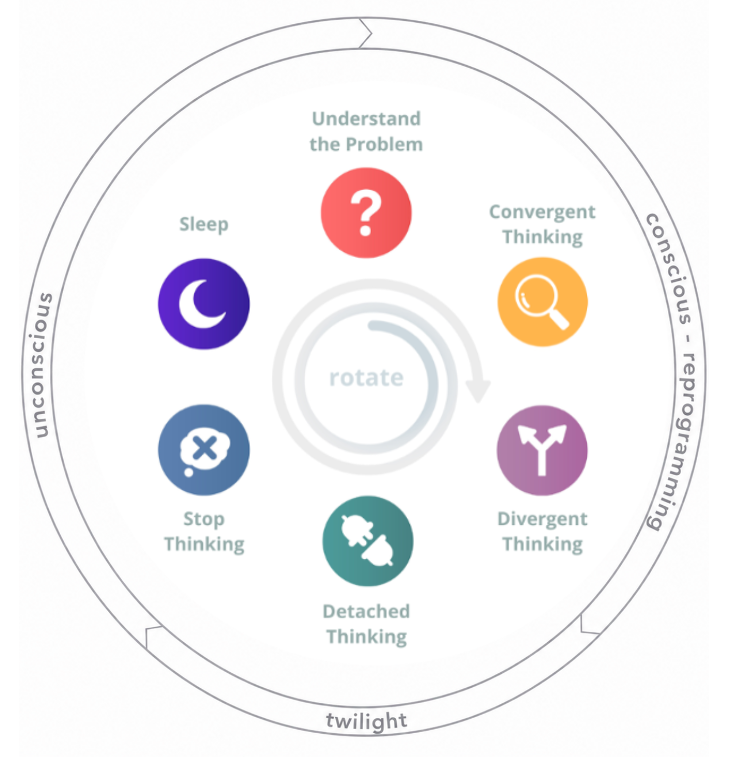
The Six Step Cycle
The Six Step Cycle is a structured method for moving from focus to insight. It helps people move deliberately between focused thinking, cognitive exploration and unconscious processing.
The first three steps use focused, conscious thinking to define, explore and structure the challenge. The final three steps create the conditions for unconscious processing, helping people detach from the problem so new insights can emerge.
This rhythm helps people move beyond routine thinking and develop cognitive agility in complex problem-solving.

Why thinking harder is not enough
Complex challenges often trigger more analysis, more meetings and more structure. That may clarify the problem, but it can also reinforce routine thinking.
The Six Step Cycle starts from a different principle: better problem-solving depends on knowing when to focus, when to release and how to create the conditions for insight.
Deep insight requires a different mental state
Most organisations are strong in focused thinking: analysing, structuring, discussing and deciding. But under pressure, sustained analysis can narrow perspective and reinforce familiar solutions.
The Six Step Cycle helps leaders and teams move beyond that pattern by accessing a different mental state: relaxed concentration.
This state combines stable attention with lower mental pressure. It allows people to detach from the problem without losing direction, creating space for unconscious processing.
That is what makes the Six Step Cycle unique: it helps people tap into unconscious resources more deliberately. Neural headsets provide real-time neurofeedback, making mental states visible and trainable.
From method to behaviour
The Six Step Cycle is practical. People work with real challenges while learning to recognise the cognitive states that support focus, relax and insight. Over time, the method helps interrupt routine thinking, improve strategic conversations and create better conditions for complex problem-solving. This leads to sharper thinking, faster insight and more effective behaviour.
Ready to apply the Six Step Cycle to a real challenge?
The Six Step Cycle is designed for three groups: executives and senior management, talent development and high potential programs, and professionals and teams under sustained cognitive pressure. The method helps people improve how they think, decide and solve complex problems. The goal is not only to understand the Six Step Cycle, but to apply it to real challenges: sharper decisions, stronger ideas, faster insight and measurable impact.
